BruhnBruhn Innovation has been selected as one of only 150 companies to join the NATO DIANA 2026 Challenge Programme

Uppsala, Sweden, Dec 10, 2025

🎗️ We are excited to share that BruhnBruhn Innovation has been selected as one of only 150 companies to join the NATO DIANA 2026 Challenge Programme Cohort—chosen from a record-setting 3,680 applicants across the Alliance ✨.

Our solution, Dacreo® apto – a cloud-native, hardened Kubernetes environment for resilient on-orbit operations, was selected under the Resilient Space Operations challenge area. Dacreo apto enables distributed autonomy, secure real-time processing, and reduced bandwidth dependency—critical capabilities for next-generation battle management, command, communications, and control.

Over the next six months, we will work closely with a NATO DIANA-affiliated Accelerator Site and DIANA’s network of experts, mentors, and test centres to refine our solution and adapt it to operational needs. This programme provides a unique opportunity to deepen our technological readiness, strengthen our understanding of defence and dual-use markets, and validate our capabilities within world-class NATO test environments.

We look forward to engaging with end users early, co-developing new mission applications, and shaping a pathway toward adoption by NATO and Allied forces—together with partners and supporters enabling our vision of Cloud Everywhere, including Blue Marble Communications, T2S Solutions, Netnod, our fellow NATO DIANA alumni SaraniaSat and Rymdstyrelsen (the Swedish National Space Agency) to mention a few.

We congratulate our fellow innovators and are excited to embark on this journey together.

Discover the full 2026 cohort here:
https://lnkd.in/eMHcMDWa

More news

NATO DIANA Mission Track Kicks Off in Tallinn

BruhnBruhn Innovation joined NATO DIANA and the wider defence innovation community in Tallinn for Mission Track Startup Days and Estonian Defence Week. The week brought together discussions on defence innovation, digital transformation, and the future of multi-domain operations.

Read more

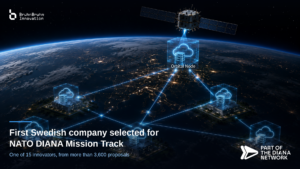
BruhnBruhn Innovation selected for NATO DIANA Mission Track

BruhnBruhn Innovation has been selected as one of 15 companies advancing to NATO DIANA’s Mission Track, marking an important milestone in our journey toward operational adoption. Through Mission Track, we will continue developing Dacreo for resilient, interoperable, and cloud-native space operations.

Read more

The Digital Space Consortium is Officially Established

The Digital Space Consortium (DSC) has officially been established, bringing together Blue Marble Communications, Mitsubishi Electric Corporation, and BruhnBruhn Innovation to advance open, interoperable software standards for space. BruhnBruhn Innovation's CTO, Fredrik Bruhn, has been appointed Chairman of the Consortium.

Read more

MOU with Mitsubishi Electric and Blue Marble Communications

BruhnBruhn Innovation, Mitsubishi Electric, and Blue Marble Communications sign MOU at Kanagawa Space Summit

Read more

Cloud-native AI runs in orbit for the first time

Salt Lake City, Utah, August 11, 2025

On 24 July 2025, BruhnBruhn Innovation, SaraniaSat, NV5 Geospatial Software, Netnod, and Hewlett Packard Enterprise executed a first-of-its-kind demonstration aboard the International Space Station. A containerised AI pipeline ran in orbit on HPE’s Spaceborne Computer-2, processed a 1.5 GB satellite image scene in real time, and returned a mission product of 75 kB to the ground. Results were available in seconds. The pipeline was deployed via a standard git push from Earth.

The demonstration was the first validated execution of a Kubernetes-orchestrated, containerised AI workload in an operational space environment.

The challenge

Modern Earth-observation satellites generate data volumes that far exceed what can practically be transmitted to ground. A single multispectral scene from a MAXAR WorldView-3 sensor runs to approximately 1.5 GB. Transmitting raw imagery is slow, expensive, and increasingly impractical as constellation sizes grow. Missions need intelligence extracted where the data is generated, in orbit, not hours later after a ground pass and a processing pipeline on Earth.

At the same time, deploying standard cloud software on space hardware is not straightforward. Cosmic ray upsets can corrupt running containers in ways that do not trigger a process crash. Clock drift breaks secure connections. A failed software update can leave a spacecraft unreachable thousands of kilometres away. These are problems that standard Kubernetes does not address.

Dacreo apto was built to solve both.

What happened on 24 July 2025

SaraniaSat’s Airborne Moving Target Identification application, built on TensorFlow and integrated with NV5 Geospatial Software’s ENVI analytics suite, was packaged as a standard OCI container and deployed to a k3s cluster running on HPE’s Spaceborne Computer-2 aboard the ISS. The deployment used a standard GitOps pipeline: a git commit on the ground became a running container in orbit.

Full-resolution WorldView-3 multispectral imagery, eight spectral bands at approximately 1.5 GB per scene, was uplinked to the ISS via NASA’s Tracking and Data Relay Satellite network. The application ran a two-stage AI pipeline onboard. In the first stage, a feedforward neural network scanned downsampled imagery for candidate regions. In the second stage, a convolutional neural network applied full-resolution analysis to confirm detections. The pipeline identified a single flying aircraft in the vicinity of Dubai.

Only the processed result was downlinked: a geolocated KMZ overlay of approximately 75 kB.

The numbers tell the story clearly. A 20,000x reduction in transmitted data volume. Latency from hours to seconds. No space-specific modifications to application code. The same workflow a developer uses on Earth, running in orbit.

Why it matters

Processing data in orbit changes the economics and the operational tempo of space missions simultaneously. Bandwidth cost scales with transmitted volume, and raw imagery is the most expensive thing to move. Moving intelligence instead of data slashes downlink cost, accelerates decision-making, and enables mission architectures that are simply not feasible under a ground-centric processing model.

For defence applications, the implications are direct: immediate situational awareness, autonomous moving-target tracking, and decision support that does not depend on a round trip to a ground station. For civil and commercial operators, the same architecture enables near-real-time disaster mapping, environmental monitoring, and subscription analytics delivered through API endpoints rather than raw data archives.

The demonstration also confirmed something architecturally significant. Standard OCI containers, GitOps delivery pipelines, and GPU-accelerated AI frameworks execute reliably in the LEO radiation and connectivity environment without requiring space-specific rewrites. The terrestrial cloud and the orbital edge are now the same compute environment.

Partners

SaraniaSat provided the Moving Target Identification application and mission expertise. Hewlett Packard Enterprise provided Spaceborne Computer-2 and access to the ISS compute environment. NV5 Geospatial Software contributed the ENVI Deep Learning analytics suite. Netnod provided secure, resilient networking architecture supporting Dacreo apto development. Financial support was provided by the Swedish National Space Agency.

Read the full case study

For a detailed account of the demonstration architecture, the two-stage AI pipeline, and the results, read the full case study.

More news

NATO DIANA Mission Track Kicks Off in Tallinn

BruhnBruhn Innovation joined NATO DIANA and the wider defence innovation community in Tallinn for Mission Track Startup Days and Estonian Defence Week. The week brought together discussions on defence innovation, digital transformation, and the future of multi-domain operations.

Read more

BruhnBruhn Innovation selected for NATO DIANA Mission Track

BruhnBruhn Innovation has been selected as one of 15 companies advancing to NATO DIANA’s Mission Track, marking an important milestone in our journey toward operational adoption. Through Mission Track, we will continue developing Dacreo for resilient, interoperable, and cloud-native space operations.

Read more

The Digital Space Consortium is Officially Established

The Digital Space Consortium (DSC) has officially been established, bringing together Blue Marble Communications, Mitsubishi Electric Corporation, and BruhnBruhn Innovation to advance open, interoperable software standards for space. BruhnBruhn Innovation's CTO, Fredrik Bruhn, has been appointed Chairman of the Consortium.

Read more

MOU with Mitsubishi Electric and Blue Marble Communications

BruhnBruhn Innovation, Mitsubishi Electric, and Blue Marble Communications sign MOU at Kanagawa Space Summit

Read more

BruhnBruhn Innovation announces Dacreo apto: Europe’s first Kubernetes-compatible spacestack

Uppsala, Sweden, August 7, 2025

BruhnBruhn Innovation has announced Dacreo apto, a patent-pending Kubernetes-compatible spacestack for cloud-native operations in orbit. Validated on state-of-the-art space computing hardware and designed from the ground up for the demands of the space environment, Dacreo apto is the first European spacestack of its kind.

The announcement marks the culmination of sustained development work combining expertise from edge computing, embedded systems, cloud infrastructure, aviation, railway, robotics, and space engineering. Dacreo apto makes it possible for mission teams to deploy, update, and recover containerised applications on space hardware using the same DevOps tools and workflows they use on Earth.

The problem Dacreo apto solves

As satellite constellations grow and sensor capabilities advance, the volume of data generated in orbit is outpacing the capacity of ground-centric architectures to handle it. Missions increasingly need to process data where it is generated, aboard the spacecraft, and transmit only the results. At the same time, the software lifecycle of a satellite has historically been slow, difficult, and high risk. Updates are complex, failures are hard to recover from, and the tools that terrestrial cloud teams take for granted simply do not exist in orbit.

Deploying standard Kubernetes on space hardware does not close this gap. Cosmic ray bit-flips can corrupt running containers without triggering a process crash. Clock drift breaks TLS connections. A failed update can leave a spacecraft unrecoverable thousands of kilometres from the nearest engineer. These are not edge cases. They are routine conditions in the space environment.

Dacreo apto addresses all of them at the platform level, so mission teams do not have to.

What Dacreo apto delivers

At its core, Dacreo apto gives mission teams a complete GitOps workflow for space. Developers commit Helm charts or Kustomize overlays to a standard Git repository. The cluster in orbit reconciles, validates, and deploys. One git push from ground to orbit.

The platform is built on Dacreo OS, an immutable Yocto 5.0-based Linux distribution with a read-only, cryptographically verified root filesystem. A separate writable data partition isolates mutable workloads. Atomic A/B updates are signed with X.509 cryptography and validated before activation. If validation fails, the system rolls back automatically to the last known-good state. A dedicated factory recovery partition handles worst-case scenarios without physical access.

A Space Manager microservice monitors running services for anomalous behaviour, including silent computation errors caused by radiation effects that would not trigger a standard process crash. It enables autonomous detection, restart, and quarantine of affected workloads between contact windows. The Dacreo AI Foundation provides a pre-integrated AMD ROCm compute environment across GPU, NPU, and FPGA, so application developers inherit a validated acceleration stack without building or maintaining it themselves.

For data handling across intermittent links, Dacreo apto includes transparent S3-compatible synchronisation between orbit and ground. An optional CCSDS Space Packet Protocol microservice provides backwards compatibility with legacy telemetry systems, making spacecraft data endpoints addressable by standard cloud tooling with no special adaptations required.

Validated on the world’s most capable space computer

Dacreo apto was validated end-to-end on Blue Marble Communications’ Space Edge Processor, which integrates AMD 4nm APU technology with Xilinx Versal FPGA fabrics, dual 10GbE payload interfaces, and dual 100GbE optical interfaces within a sub-100W envelope. Dr. Fredrik Bruhn personally oversaw integration and testing at Blue Marble Communications’ laboratory in California, running heavy workloads and verifying seamless operation of the BMCnet network driver across link interruptions.

The platform also supports the AMD V1000 series and other CPU architectures, giving mission designers flexibility across a range of space-grade hardware configurations.

Partners and acknowledgements

Dacreo apto was developed in strategic partnership with Netnod, whose secure and resilient networking architecture contributed directly to the platform’s cloud-native foundation. Financial support was provided by the Swedish National Space Agency. CCSDS and ECSS-PUS library support and training is provided by 12G Flight Systems.

“Connecting ground and space through cloud-native workflows is our vision. Seeing our spacestack thrive under the harshest conditions proves that software-defined infrastructure is key to the next era of space services.” — Dr. Fredrik Bruhn, Chairman and Chief Technologist, BruhnBruhn Innovation

What comes next

Less than three weeks after this announcement, Dacreo apto was validated in orbit. On 24 July 2025, a containerised AI pipeline deployed via Dacreo apto ran aboard the International Space Station, reducing a 1.5 GB satellite image scene to a 75 kB mission product in seconds. Read the full account of that demonstration in the case study below.

Getting started

BBI offers edge development kits with pre-configured AMD APU hardware and pre-loaded Dacreo apto images for local prototyping and testing before orbital deployment. Virtual lab environments provide Docker and VM-based emulation of the full spacestack including the ROCm AI Foundation, Kubernetes control plane, and simulated CCSDS links for CI integration and continuous testing. Software licensing, training, and professional services are available for teams moving toward mission deployment.

Read the case study

For a detailed account of Dacreo apto running in orbit aboard the ISS, including the full demonstration results, read the case study.

More news

NATO DIANA Mission Track Kicks Off in Tallinn

BruhnBruhn Innovation joined NATO DIANA and the wider defence innovation community in Tallinn for Mission Track Startup Days and Estonian Defence Week. The week brought together discussions on defence innovation, digital transformation, and the future of multi-domain operations.

Read more

BruhnBruhn Innovation selected for NATO DIANA Mission Track

BruhnBruhn Innovation has been selected as one of 15 companies advancing to NATO DIANA’s Mission Track, marking an important milestone in our journey toward operational adoption. Through Mission Track, we will continue developing Dacreo for resilient, interoperable, and cloud-native space operations.

Read more

The Digital Space Consortium is Officially Established

The Digital Space Consortium (DSC) has officially been established, bringing together Blue Marble Communications, Mitsubishi Electric Corporation, and BruhnBruhn Innovation to advance open, interoperable software standards for space. BruhnBruhn Innovation's CTO, Fredrik Bruhn, has been appointed Chairman of the Consortium.

Read more

MOU with Mitsubishi Electric and Blue Marble Communications

BruhnBruhn Innovation, Mitsubishi Electric, and Blue Marble Communications sign MOU at Kanagawa Space Summit

Read more

BruhnBruhn attends SmallSat 2025

Salt Lake City, Utah, August 2025

BruhnBruhn Innovation is attending the 39th Annual Small Satellite Conference in Salt Lake City, Utah, August 10 to 13, and is using the occasion to formally introduce Dacreo apto, its hardened cloud-native spacestack for orbital operations. Dr. Fredrik Bruhn, Chairman and Chief Technologist of BruhnBruhn Innovation, is attending and available to meet with partners and prospective customers throughout the conference.

Dacreo apto is the result of years of research, development, radiation testing, and system validation. It brings cloud-native operations to space hardware, enabling mission teams to deploy and manage containerised applications in orbit using the same tooling and workflows they already rely on in terrestrial cloud environments.

The platform is validated on Blue Marble Communications’ Space Edge Processor, built on AMD’s 7nm V2000 series APU, and includes full support for the BMCnet driver. It also supports the older AMD V1000 series and other CPU architectures, giving mission designers flexibility across a range of space-grade hardware configurations.

Dacreo apto introduces several capabilities developed specifically for the demands of the space environment. A patent-pending orchestration hardening layer addresses the reliability challenges that standard Kubernetes cannot handle in orbit, including cosmic ray upsets and the impossibility of physical intervention. Fail-safe A/B root filesystem updates with automatic rollback ensure that a failed software delivery can never leave a spacecraft unrecoverable. The root filesystem is read-only by design, with X.509 cryptographic signing of all update bundles and a dedicated factory recovery partition for worst-case scenarios.

A Space Manager microservice provides execution trust and operational intelligence, monitoring running services for anomalous behaviour and enabling autonomous mitigation between ground contact windows. The platform supports backwards compatibility with CCSDS Space Packet Protocol, allowing integration with legacy telemetry systems alongside native onboard orchestration and industry-standard S3-compatible storage interfaces.

For AI and data processing workloads, Dacreo apto includes radiation-hardened acceleration support across GPU, NPU, and FPGA fabrics, drawing on the Dacreo AI Foundation compute environment.

The reliability principles behind Dacreo apto were drawn deliberately from industries where failure is not an option. Aviation, railway, gaming, and robotics each contributed lessons about software update safety, execution monitoring, and graceful degradation that informed the platform’s architecture.

Dacreo apto was developed in partnership with Netnod, a Swedish internet infrastructure organisation marking 25 years of 100% availability, whose CIO and Head of Security Mattias Ahnberg contributed to the platform’s secure networking architecture. The platform has undergone peer review from international space specialists and has been tested alongside leading cloud infrastructure providers.

Dr. Fredrik Bruhn is available for meetings throughout SmallSat 2024. Teams interested in extending their terrestrial cloud infrastructure into orbit are encouraged to reach out directly.

More news

NATO DIANA Mission Track Kicks Off in Tallinn

BruhnBruhn Innovation joined NATO DIANA and the wider defence innovation community in Tallinn for Mission Track Startup Days and Estonian Defence Week. The week brought together discussions on defence innovation, digital transformation, and the future of multi-domain operations.

Read more

BruhnBruhn Innovation selected for NATO DIANA Mission Track

BruhnBruhn Innovation has been selected as one of 15 companies advancing to NATO DIANA’s Mission Track, marking an important milestone in our journey toward operational adoption. Through Mission Track, we will continue developing Dacreo for resilient, interoperable, and cloud-native space operations.

Read more

The Digital Space Consortium is Officially Established

The Digital Space Consortium (DSC) has officially been established, bringing together Blue Marble Communications, Mitsubishi Electric Corporation, and BruhnBruhn Innovation to advance open, interoperable software standards for space. BruhnBruhn Innovation's CTO, Fredrik Bruhn, has been appointed Chairman of the Consortium.

Read more

MOU with Mitsubishi Electric and Blue Marble Communications

BruhnBruhn Innovation, Mitsubishi Electric, and Blue Marble Communications sign MOU at Kanagawa Space Summit

Read more