Today, we are proud to announce that BruhnBruhn Innovation has been selected to join the NATO DIANA 2026 Challenge Programme Cohort, under the challenge area Resilient Space Operations. From a record-breaking 3,680 applications, only 150 companies across all 32 NATO nations were chosen—marking a major milestone for our team and for the space-software community in Europe.
For us, this is more than a recognition. It is a clear signal that the Alliance is preparing for a future where space systems must be as adaptive, secure, and software-defined as modern cloud infrastructure on Earth.
And this is exactly the future dacreo® apto was built for.
A Cloud-Native Leap for Space Missions
Space systems today face a convergence of challenges: bandwidth bottlenecks, contested electromagnetic environments, rapidly evolving mission needs, and increasingly sophisticated adversaries. Traditional spacecraft architectures—tightly coupled, slow to update, and difficult to secure—struggle under these pressures.
Our solution, dacreo apto, brings a cloud-native, Kubernetes-compatible space stack into orbit, enabling:
Real-time onboard AI/ML analytics
Massive downlink reduction through selective, insight-based data delivery
Distributed autonomy across proliferated constellations
Secure DevSecOps pipelines for rapid mission software updates
Resilient operations using our patent pending fault monitoring method
In 2025, our collaboration with SaraniaSat and HP Enterprise demonstrated the power of this approach—running AI/ML inference on orbit-representative hardware, showing how cloud-native analytics can bridge Earth and space and unlock insights dramatically faster than traditional pipelines. Read more.
Later that same year, we introduced dacreo apto as the first European Kubernetes-compatible space stack validated on state-of-the-art American space computer hardware. This enabled fully containerized mission applications, Helm-based deployments, and automated recovery directly on space-grade processors. Read more.
DIANA’s recognition is the next step forward.
Why Resilient Space Operations Matter
The DIANA challenge area reflects a strategic shift across NATO: space is no longer only an enabler—it is a domain of active competition. Future missions will require:
Low-latency decision loops
Hardened AI pipelines
Autonomous coordination between satellites
Secure, updateable software architectures
Interoperability across national and commercial systems
NATO’s push for modular and open standards aligns perfectly with what dacreo apto already supports: cloud-native interfaces, zero-trust update mechanisms, and Kubernetes-based service orchestration. This creates a shared ecosystem where Allied operators and application developers can build once and deploy everywhere—from the ground to LEO and beyond.
The DIANA Programme: A Catalyst for Allied Innovation
Over the next six months, we will work alongside DIANA’s accelerator network, test centres, and mentors to refine our technology and ensure it meets operational requirements across the Alliance.
The programme offers:
Contractual funding for core development
Access to 16 accelerator sites around NATO nations
Hands-on experimentation with world-class TEVV facilities
Direct engagement with Allied defence users
A pathway to prototyping and adoption
We expect to demonstrate how containerized applications can be securely deployed to space systems, how dynamic AI/ML pipelines reduce bandwidth demand, and how cloud-native autonomy strengthens operational resilience during conflict.
Building on a Year of Breakthroughs
2025 marked a turning point for BruhnBruhn Innovation:
We demonstrated onboard AI/ML analytics with SaraniaSat and HP Enterprise, proving that real-time intelligence extraction in orbit is both feasible and game-changing.
We launched dacreo apto, introducing Kubernetes and secure DevOps workflows into the space domain for the first time in Europe.
We worked with leading partners and supporters including Blue Marble Communications, Netnod, and the Swedish National Space Agency to validate our stack on real flight hardware.
Each milestone has helped us build toward a vision of cloud-native space infrastructure that is as agile, secure, and scalable as terrestrial cloud computing.
A Shared Vision: Cloud Everywhere
We believe space is becoming the next compute environment—one that must seamlessly integrate with terrestrial cloud, tactical edge systems, and secure military networks. dacreo apto allows mission designers, defence users, and commercial satellite operators to:
Build and deploy new applications in days, not years
Move intelligence instead of raw data
Strengthen resilience through distributed autonomy
Joining DIANA’s 2026 cohort allows us to take this vision and accelerate it into operational reality—together with Allies, industry partners, and NATO’s innovation ecosystem. Read more.
Looking Ahead
We are deeply honoured to join this cohort and eager to collaborate with peers across the Alliance. The next six months will be a period of intense development, testing, and learning—but also of building lasting partnerships that can shape the future of secure, cloud-native space operations.
On July 24, 2025, a unique international partnership of SaraniaSat, BruhnBruhn Innovation (BBI), NV5 Geospatial Software, Netnod, and Hewlett Packard Enterprise (HPE) brought true cloud-native computing to the International Space Station (ISS).
The ISS isn’t just home to astronauts—it’s one of the most versatile science labs ever built. Operated by NASA, ESA, JAXA, CSA, and Roscosmos, it serves as a National Laboratory where companies and researchers validate cutting-edge technologies in the real space environment. Our project grew from this opportunity: to show that cloud-native, Kubernetes-based applications can run reliably in orbit, delivering real-time insights directly from space.
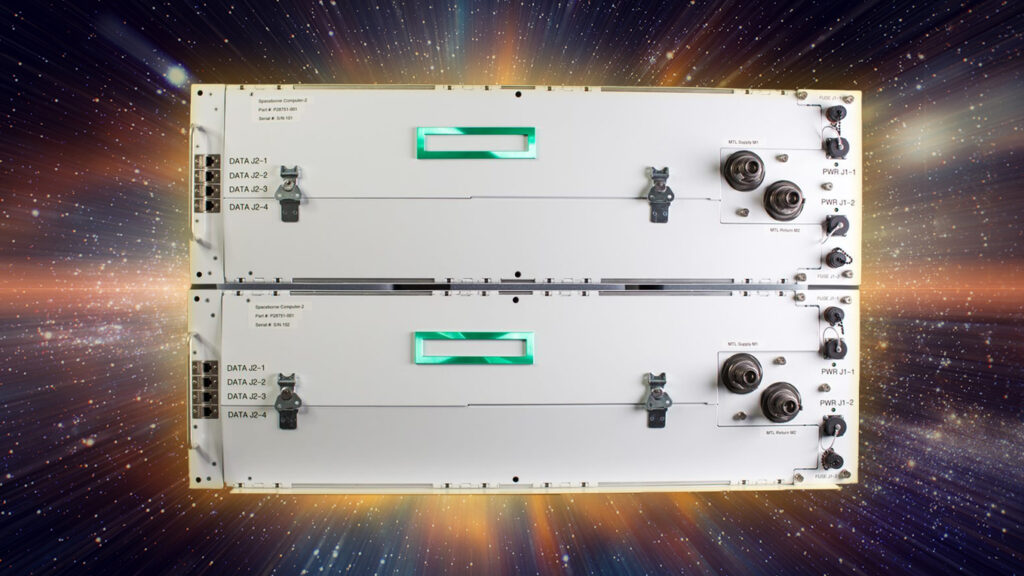
Picture of HPE’s Spaceborne Computer-2 on the International Space Station(Courtesy of HPE)
As humanity launches more sensors and satellites, the flood of Earth-observation and scientific data is overwhelming ground-centric systems. Waiting hours—or days—for raw imagery and telemetry to be downlinked, processed on Earth, and then sent back up introduces cost, latency, and limits on autonomy. From disaster response to on-orbit manufacturing, future missions demand immediate insights and self-healing operations that simply can’t wait for a round trip to the ground.
Edge computing in space solves this by processing large datasets directly aboard satellites, stations, or probes. But deploying off-the-shelf Kubernetes on standard Linux leaves critical gaps: cosmic rays can corrupt memory and crash containers, clocks drift apart and break secure connections, and any failed update can render a space asset unusable thousands of kilometers away.
From Idea to Orbit: A Back Story
Challenge
Data Deluge: A single MAXAR WorldView-3 multispectral data cube consisting of 8 bands can be ~1.5 GB. Transmitting that raw is slow, non-timely, not responsive and costly.
Operational Risk: Space hardware can’t be manually rebooted or reinstalled if software fails.
Standard Kubernetes: Does not have space hardening or space mission suitable services, for instance, typically lacking Delay Time Networking.
NV5 Geospatial Software delivered advanced image analytics through the ENVI suite.
Netnod secure, resilient networking architectures supporting dacreo apto development
BruhnBruhn Innovation created dacreo apto, a hardened, Kubernetes-compatible spacestack.
Validation on the International Space Station
Full-resolution multi-spectral satellite images were uplinked by HPE to the ISS using NASA TDRS network.
On-orbit processing identified flying aircraft in seconds and transmitted the processed result back through NASA TDRS.
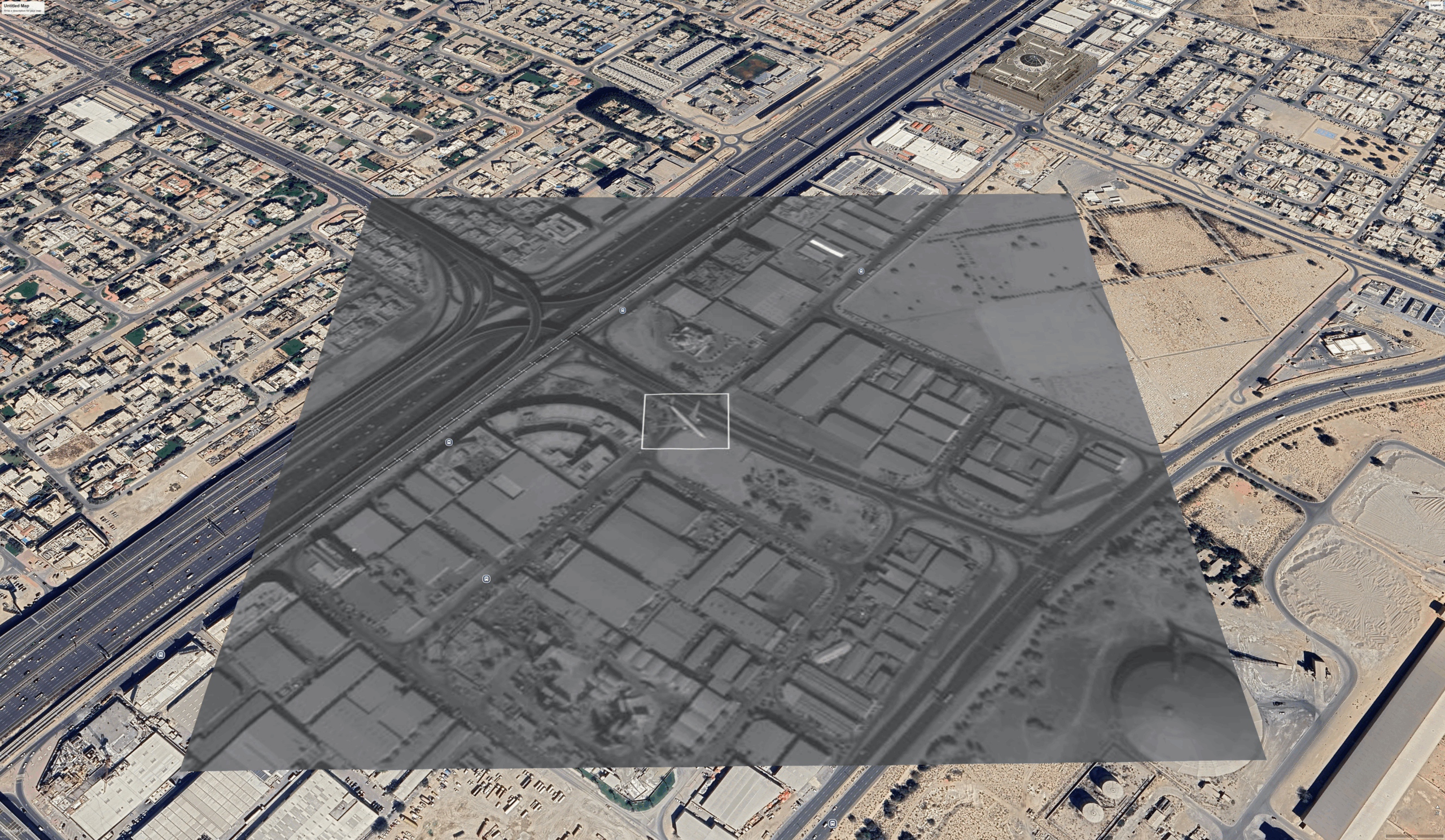
Example of result: A still image of a geolocated moving airplane kmz file using Google Earth. Airplane detected in the vicinity of Dubai. Data reduced 20 000 times in real-time and downlinked as geolocated kmz information. Courtesy of SaraniaSat.
The Demonstration
Instead of waiting for raw imagery to trickle back to Earth, our consortium deployed SaraniaSat’s Moving Target Identification application—packaged as a Kubernetes pod for the BBI dacreo apto spacestack—onto a k3s cluster on HPE’s Spaceborne Computer-2. Full-resolution MAXAR WorldView-3 images were uplinked to the ISS, processed in real time, and only the geolocated overlays were downlinked, delivering near-real-time visibility of flying airplanes.
20 000× Data Reduction: 1.5 GB raw → ~75 kB KMZ overlay
11.7 million× Reduction for Coordinates: 1.5 GB raw → 128 B coordinate packet
Low Latency: Results available in seconds, not hours
Broad Reach: Lightweight packets can be sent via any satcom channel or even direct to devices (e.g. 6G/5G/Bluetooth networks)
This flow—from a git commit on Earth to a container running in orbit—demonstrates that DevOps practices can bridge the terrestrial cloud and the “space cloud” seamlessly.
Observe, reason, and act immediately
Predicting future events in space depends on three streams of knowledge: the historical data we’ve already collected, timely Earth-based intelligence uplinked to the asset, and real-time information from other orbiting platforms. Sorting through these vast volumes of sensor, imagery, and telemetry data—then communicating the distilled insights in standardized formats—is what makes true multi-domain operations (MDO), global command & control, and data-driven business models possible.
Google Earth video of a detection using SaraniaSat’s Moving Target ID intelligence application packaged as a dacreo apto container. Courtesy of SaraniaSat.
Why It Matters
Processing data in orbit slashes both latency and bandwidth costs, enabling truly responsive, time-critical applications. Earth‑observation firms can iterate algorithms in days instead of months; defense agencies gain rapid situational awareness; commercial operators can explore new, rapid service‑based models—subscription analytics, pay‑per‑use compute, even microservices marketplaces—without reinventing legacy space infrastructure.
Civilian Uses: Rapid disaster mapping, environmental monitoring, agricultural insights, and media coverage—all benefit from real-time data.
Business Opportunity: The global space on-board computing market was USD 1.6 billion in 2023 and is forecast to grow at double-digit rates through 2030. By enabling edge compute in orbit, we unlock subscription analytics, pay-per-use compute, and in-orbit microservices marketplaces—new revenue models for government and commercial operators alike.
“This demo on Spaceborne Computer‑2 proves that containerized AI/ML workloads can run reliably in orbit. By integrating with BruhnBruhn’s dacreo apto and SaraniaSat’s pod, we’re extending our ‘Hardening With Software’ strategy to hybrid‑cloud architectures spanning cubesats to large stations.”
Norm Follett, Director, HPE Space Technologies & Services
“Real‑time moving‑target ID from space has long been a tantalizing goal for SaraniaSat. Validating our TensorFlow+ENVI pipeline on orbit shows that indeed Kubernetes‑native DevOps can achieve the promised delivery of mission‑critical insights with unprecedented speed.”
Dr Tom George, CEO, SaraniaSat
“Connecting ground and space through cloud‑native workflows is our vision. Seeing our spacestack thrive under the harshest conditions proves that software‑defined infrastructure is key to the next era of space services.”
Dr Fredrik Bruhn, CTO, BruhnBruhn Innovation
“By leveraging NV5’s ENVI analytics on‑orbit, we enable customers to turn raw imagery into actionable intelligence almost instantly—whether it’s civilian environmental monitoring or defense operations.”
“Utilizing cloud-native solutions combined with secure and reliable networking ensures data integrity and availability end‑to‑end, from ground stations to the ISS. Proving that this is a viable solution in space as well as on earth unlocks unlimited flexibility and building on existing technologies means that the threshold for developing services for space is lowered massively.”
Mattias Ahnberg, CIO & Head of Security, Netnod
About the Partners
HPE: Provider of Spaceborne Computer‑2 by Hewlett Packard Enterprise, enabling high‑performance, space‑qualified compute.
SaraniaSat: Innovator in High Performance Edge Computing for Moving‑Target Identification, ISR and Early Warning of Crop Stress for Precision Agriculture.
NV5 Geospatial Software: Developer of ENVI, the industry’s leading geospatial analytics platform for advanced image processing and ML‑driven feature extraction.
Netnod: Provider of Internet Exchange, communication solutions, DNS-services, time- as well as security services. With a 100% uptime track record on their IX and DNS platforms for more than 20 years they are true experts in building robustness and creating rock-solid solutions.
BruhnBruhn Innovation: Creator of radiation‑hardened, Kubernetes‑compatible infrastructure—and the dacreo apto spacestack that powers cloud‑native computing in orbit.
As humanity pushes more sensors and satellites into orbit, the volume of Earth-observation and scientific data generated off-planet is exploding. Traditional ground-centric architectures—where raw imagery and telemetry must be downlinked, processed on Earth, then pushed back up—suffer from high latency, expensive bandwidth, and limited autonomy. Future missions, from disaster monitoring to in-space manufacturing, demand real-time insights and self-healing operations that simply can’t wait for a round-trip to ground.
Edge computing in space solves this by processing large data sets directly aboard satellites, space stations, or deep-space probes. But deploying off-the-shelf Kubernetes on standard Linux leaves gaps: cosmic-ray bit-flips can crash pods, clock drift breaks TLS, and any failed update risks bricking an asset thousands of kilometers away.
To address these challenges, BruhnBruhn Innovation have developed dacreo apto, a patent-pending, Kubernetes-compatible spacestack that brings cloud-native space operations to life. By embedding execution-monitoring agents, hardened OS primitives, and seamless GitOps/DevOps workflows, dacreo apto transforms disconnected, resource-constrained space platforms into resilient, self-governing compute nodes—enabling mission teams to iterate, deploy, and recover their applications just as they would in a modern terrestrial cloud.
The result is a self-healing, space-qualified platform that provide a solid cloud-native space infrastructure for critical missions:
Detects execution upsets and automatically restarts or quarantines affected pods
Provides A/B root-filesystem updates with instant rollback if validation fails
Maintains a read-only OS core, isolating mutable workloads in a separate partition for ultimate resilience
On-orbit factory reset ability
Un-synchronized time management handling of arbitrary clock skew between space assets and ground
dacreo AI Foundation based on tailored AMD ROCm and AI frameworks
Kubernetes compliant
Compared to a standard Red Hat or Ubuntu host, dacreo apto offers minimal size and cybersecurity footprint, 100% source traceability, runtime optimizations, atomic patch bundles signed with X.509 cryptography and validation, and seamless integration of hardware-in-the-loop health checks—ensuring that every container and kernel module is verified before execution.
Cloud-native Space Operations
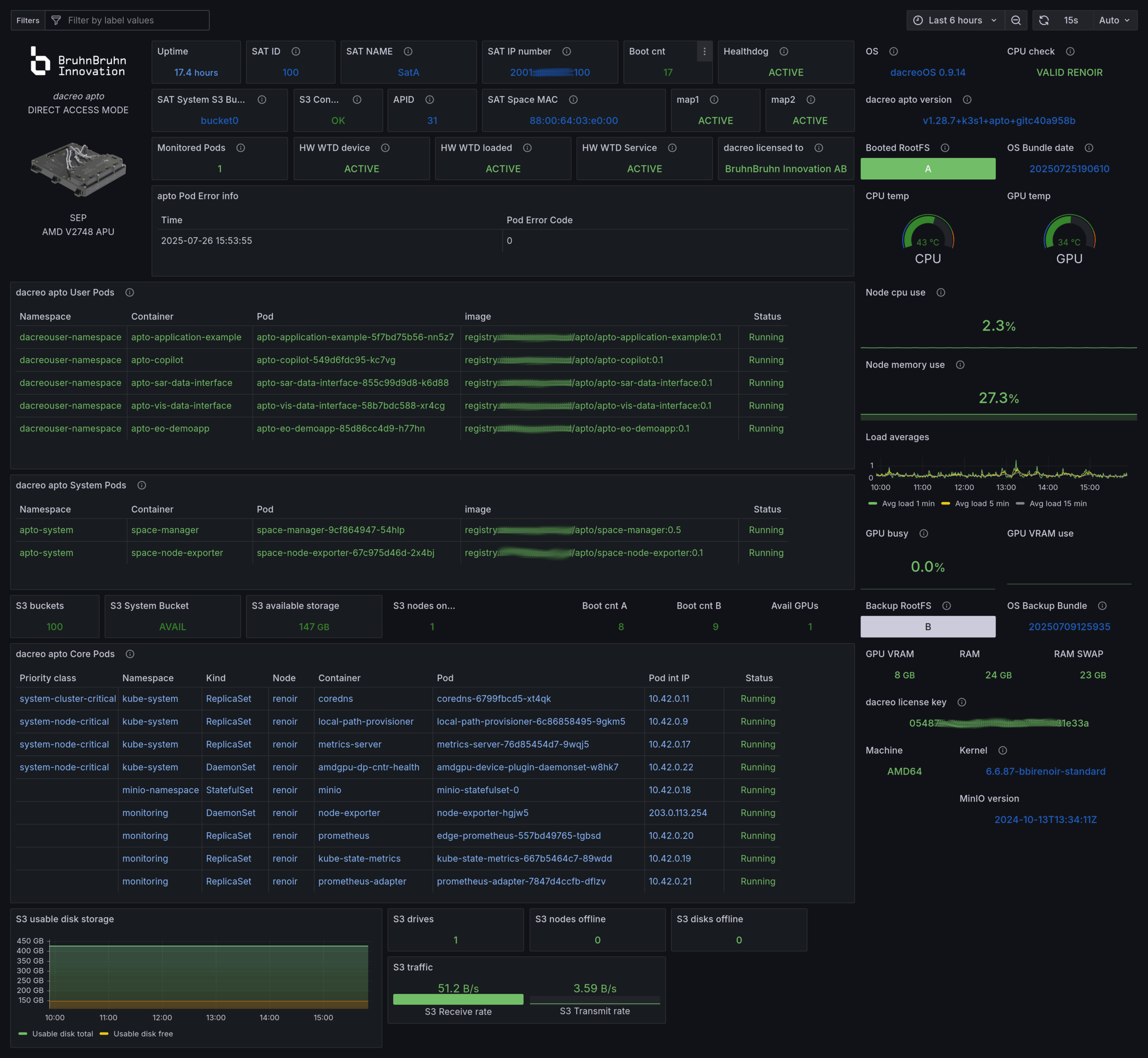
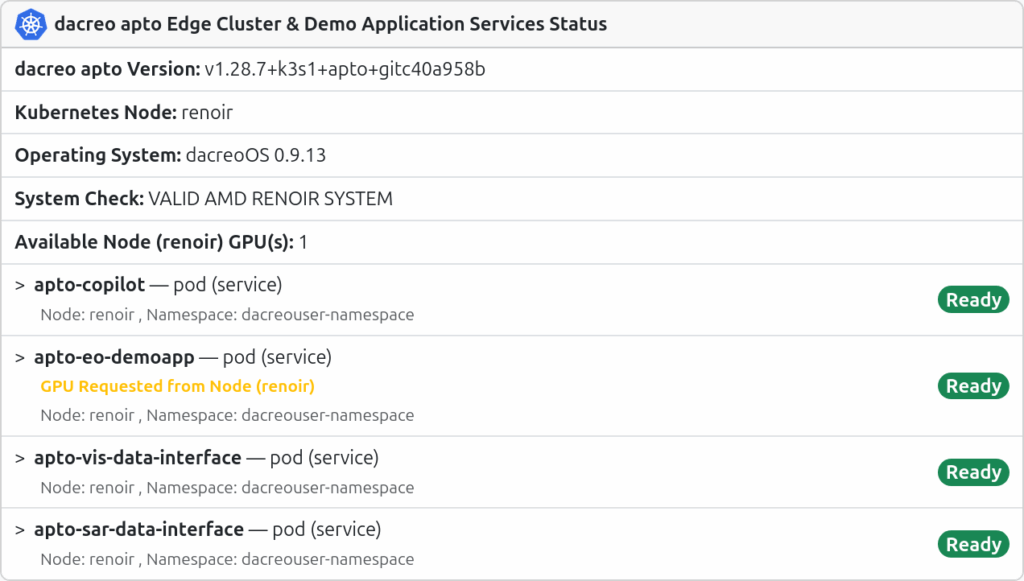
Operational dashboard screenshot of dacreo apto running on AMD Renoir architecture
dacreo apto running on AMD Renoir architecture, i.e., Ryzen 7 4000 or Embedded V2000 series family of AMD Accelerated Processing Units
At its core, dacreo apto delivers true GitOps/DevOps in orbit. Developers simply commit their Helm charts or Kustomize overlays, push to a standard Git repository, and watch as the cluster—whether on a compatible computer hardware at ground level or nested inside a satellite—automatically reconciles, validates, and deploys the new version.
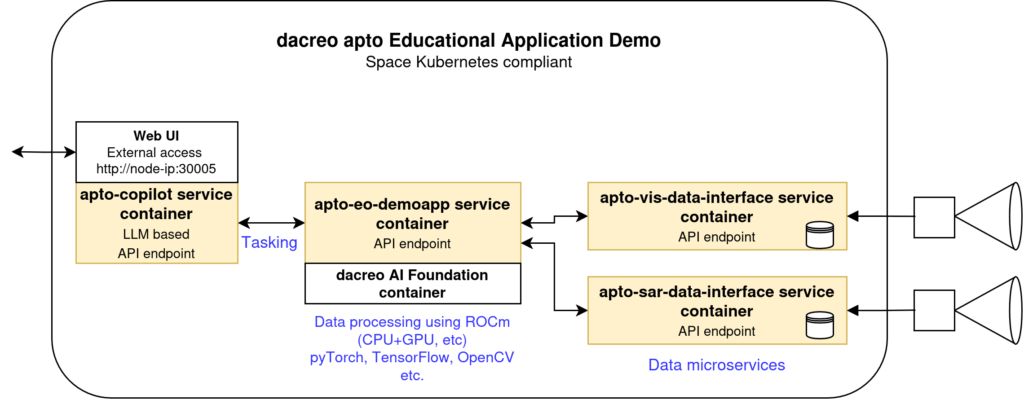
In our Space Kubernetes Lab, an operational dashboard shows a 4-service educational demo running on AMD Embedded V2000 (“Renoir”):
dacreo apto copilot service running a local Large Language Model (LLM) to interpret natural language tasking
dacreo apto eo application service running insights image processing using machine learning frameworks (based on TensorFlow and pyTorch GPU accelerated with a tailtored ROCm compute stack)
dacreo apto visual data interface service servicing raw image data from various sensors (optical, multi-spectral, hyper-spectral etc)
dacreo apto SAR data interface service servicing raw Synthetic Aperture Radar (SAR) sensor data
Each service spins up in seconds, requests CPU and GPU on the APU, and reports health via the BBI space exporter node.
Because space links remain intermittent, dacreo apto offer transparent S3 synchronization: when connected, the cluster syncs container images, application data, and logs to any S3-compatible endpoint—on-Earth or in-orbit. An optional, separately-licensed CCSDS space packet protocol microservice translates these transfers into space-packet bundles, guaranteeing backwards compatibility with legacy telemetry systems. This means ground-based CI pipelines and terrestrial cloud services can push or pull data from space assets exactly as they would with OVHcloud, EVROC, Google, AWS or Azure—no special tools required.
AI & Compute Foundations
The dacreo AI Foundation is provided as a preloaded container base image in the dacreo apto environment. Application developers simply build their own containers on top of this image to gain ROCm-enabled compute—TensorFlow, PyTorch, and other optimized libraries are already included. Because the base image lives on every apto node, only your new OCI layers (your application code and dependencies) need to be pushed, minimizing upload time and ensuring consistency from ground testbeds all the way to deep-space assets.
Designed for powerful space computers
dacreo apto is designed from the ground up to leverage the performance, power efficiency, and maturity of AMD’s Embedded APU families—architectures already gaining traction in space-edge applications:
Widely adopted in Blue Marble Communications’ Space Edge Processor, “Renoir” delivers a balanced mix of compute and graphics acceleration in a single chip. Its Zen 2 cores and integrated Radeon graphics enable on-orbit AI inference, image processing, and data fusion without separate accelerator boards.
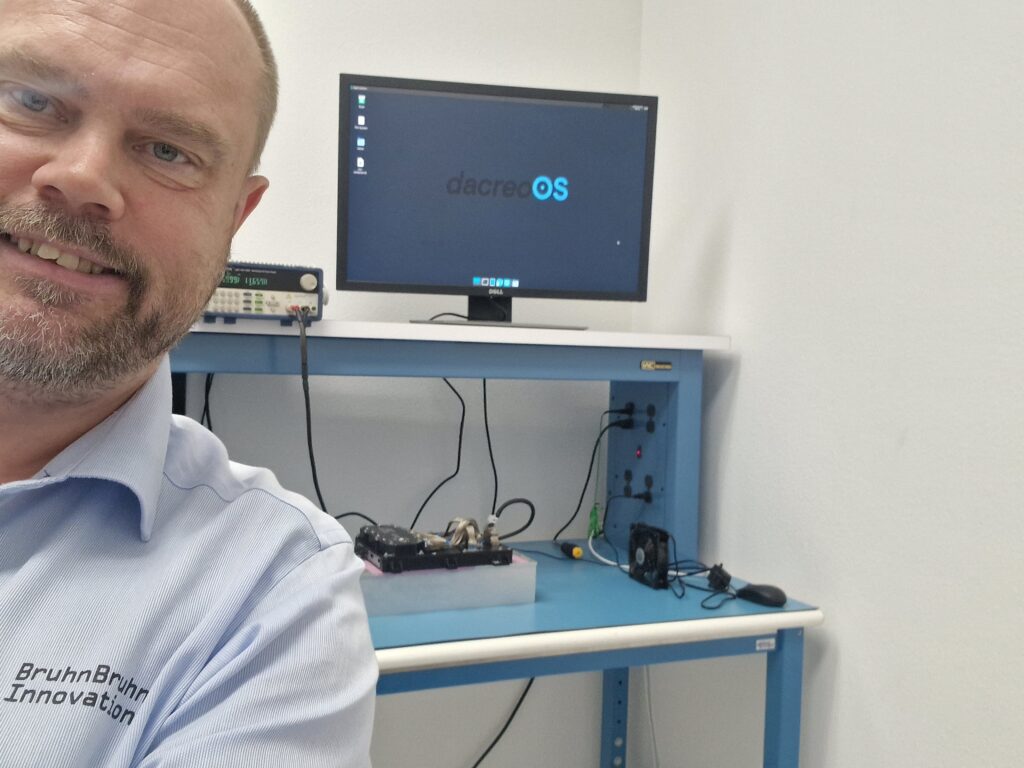
By targeting these APUs, dacreo apto unlocks a familiar development environment (x86_64 Linux + ROCm) while ensuring tight integration with space-qualified hardware. Our CTO personally oversaw end-to-end validation in Blue Marble Communications’ lab on the Space Edge Processor—running heavy workloads and verifying seamless operation of the BMCNet network driver across link interruptions. The result is a hardened spacestack that runs confidently on the same processors powering tomorrow’s edge satellites.
BBI CTO in Blue Marble Communications Laboratory during dacreo validation on the Space Edge Processor featuring AMD Embedded V2748 APU.
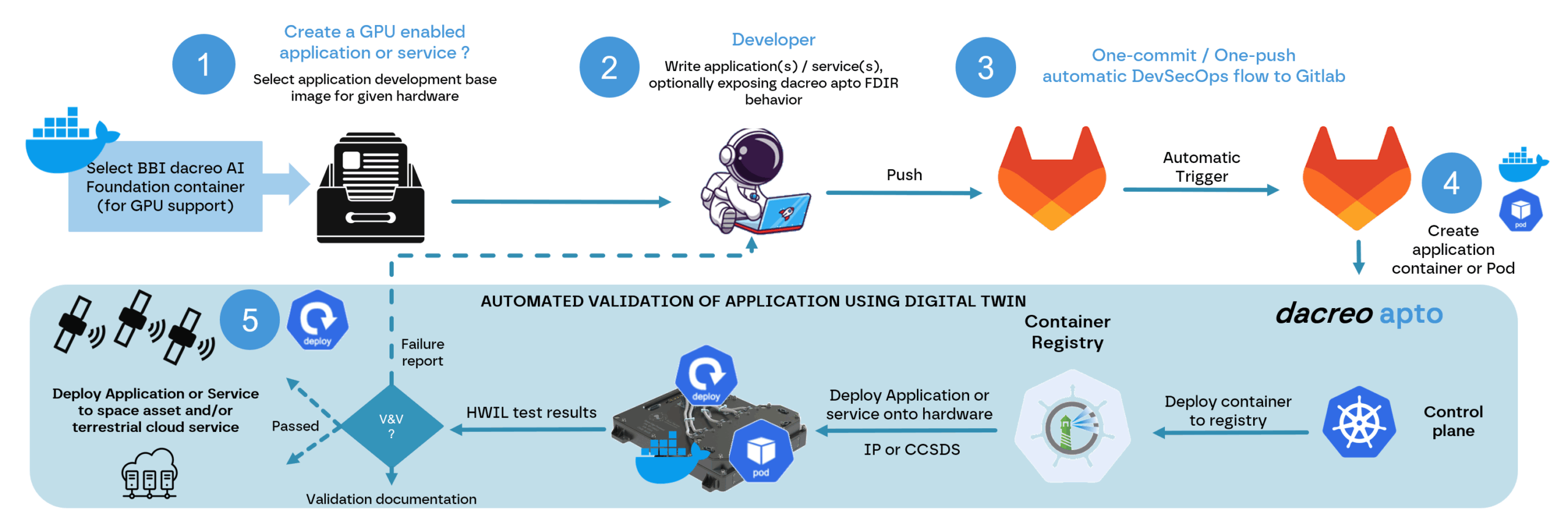
One-push standard GitOps / DevOps pipeline in BBI Space Kubernetes Laboratory
In BBI’s Space Kubernetes Lab, a single git push triggers a full hardware-in-the-loop validation:
Pre-commit hooks verify YAML syntax and signature
CI pipeline builds container images, signs them, and publishes to an S3-compatible registry
CD operator on the target apto cluster pulls new images, runs smoke tests on a redundant node
Health agent monitors execution; on failure, it re-rolls to the last known-good revision
This “one-push” flow slashes deployment times from months and weeks to minutes, and enables global teams to ship updates to dozens—or hundreds—of satellites with zero human touch.
dacreo apto devops-gitops illustration
Educational application example
To demonstrate, we deployed a four-service demo to a single Renoir node. The apto-copilot service detects available GPU resources and orchestrates the Earth-Observation insights processor, which in turn visualized optical and SAR data in real time. All interactions—service scaling, health recovery, log aggregation—were managed transparently via the standard GitOps pipeline.
dacreo apto educational app overview
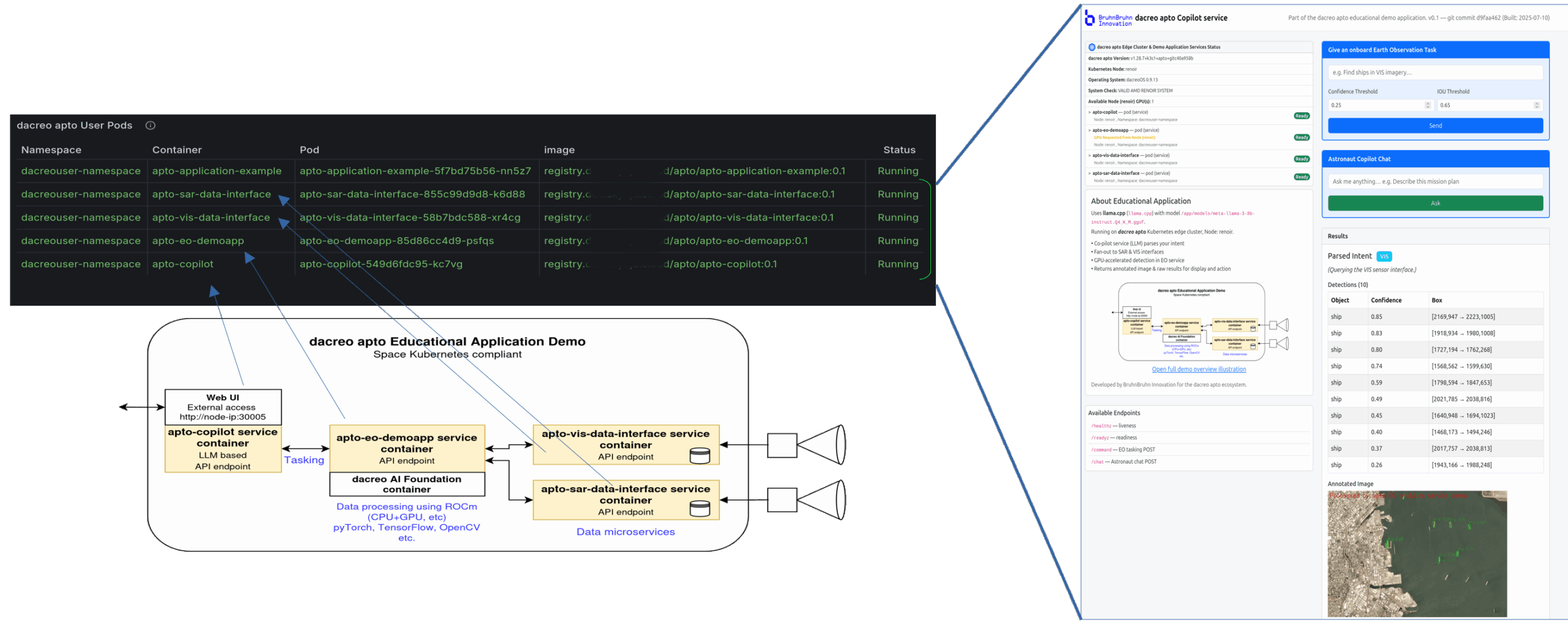
The educational demo application orchestrated on the Space Edge Processor architecture end node, and shown in the operations dashboard under dacreo apto User Pods section.
dacreo apto educational application orchestrated on the edge Kubernetes cluster in the dashboard
The educational demo services are up and running and detected by the apto copilot service as seen in this figure. There is one available GPU on the edge node (in the AMD APU) which is requested by the Earth Observation insights processing service.
dacreo apto cluster and educational application demo status
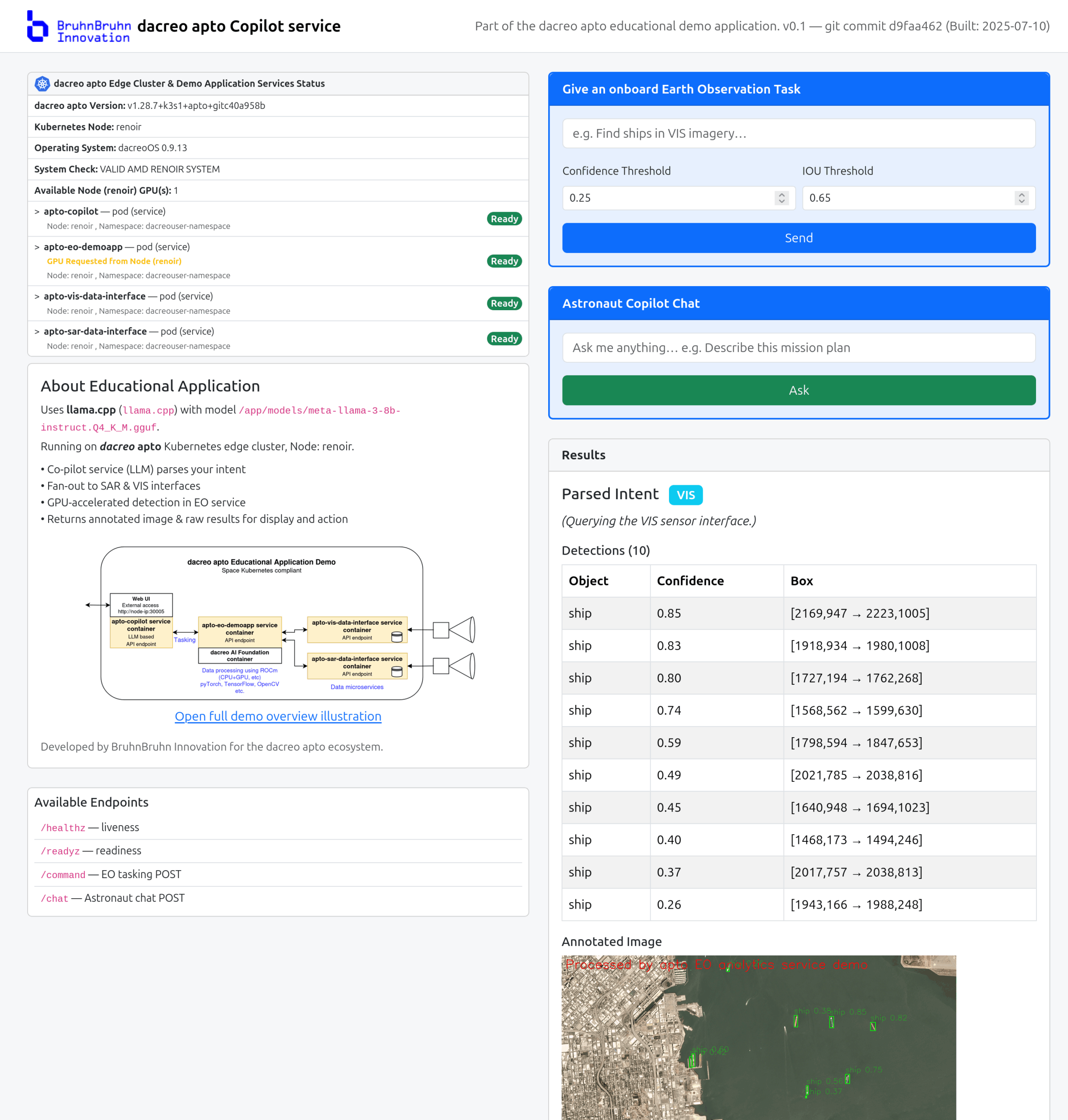
In this screenshot from the dacreo apto Copilot service dashboard, you can see how a simple “astronaut‐friendly” interface drives complex on‐orbit analytics:
All processing, from raw pixels to annotated output, happens entirely on-orbit; only the lightweight overlay and metadata need to be downlinked.
Service Status Panel (Top-Left)
Lists each running microservice—apto-copilot, apto-eo-demoapp, apto-vis-data-interface, and apto-sar-data-interface—along with their readiness.
Shows that a GPU has been successfully requested by the Earth Observation service on the AMD “Renoir” node.
Confirms that the OS and Kubernetes node are both validated as “AMD RENOIR SYSTEM”
About Educational Application (Center-Left)
Explains the four-service architecture:
Copilot (LLM) parses natural-language tasking (e.g., “Locate ships in VIS imagery…”).
EO Demo App performs GPU-accelerated inference using TensorFlow or PyTorch on optical data.
VIS Data Interface ingests raw visible-band imagery.
SAR Data Interface pulls in Synthetic Aperture Radar frames.
Highlights that all services run unmodified OCI containers on the same spacestack, demonstrating true portability across ground and orbit.
Onboard Tasking & Chat (Top-Right)
The “Give an onboard Earth Observation Task” form lets operators specify detection targets and confidence/IOU thresholds.
The Astronaut Copilot Chat window lets crew members ask free-form questions (“Describe this mission plan,” “What’s the weather in the target area?”), with the LLM interpreting intent and routing requests to the appropriate service.
Results Table & Annotated Image (Bottom-Right)
Shows parsed detections—objects, confidence scores, and bounding-box coordinates.
Displays the processed image with green bounding boxes overlaid on ships detected in a harbor scene.
dacreo apto educational application insights processing example of optical images provided by the visual data service and processed by the Earth Observation insights service using the GPU.
Why It Matters This demo underscores the power of cloud-native space operations: one Git commit can push updated models to pods in orbit, where they immediately leverage on-board GPU acceleration to generate actionable insights. The copilot GUI abstracts the complexity—astronauts or remote operators need only natural language or simple forms to drive advanced AI/ML workloads hundreds of kilometers above Earth.
Development Solutions & Software Licensing
Getting started with dacreo apto is straightforward. We offer:
Edge Development Kits: Pre-configured hardware bundles—featuring AMD APUs and pre-loaded dacreo apto images—so you can prototype and test locally before deploying to orbit.
Virtual Lab Environments: Docker- and VM-based emulators of the dacreo apto spacestack, complete with ROCm-enabled AI Foundation images, Kubernetes control plane, and simulated CCSDS/DTN links. Ideal for CI integration and continuous testing.
Software Licensing & Support
Training & Professional Services: On-site and remote workshops covering GitOps pipelines, hardware-in-the-loop validation, upset-recovery tuning, and CCSDS integration. Custom development engagements are also available.
Contact us for detailed pricing, licensing options, and to schedule a live demo of our development systems. Let’s explore how dacreo apto can unlock cloud-native operations for your next space mission.
Partners & Acknowledgments
Netnod is a strategic partner for reliable cloud-native architectures, security, and networking.
12G Flight Systems provides the CCSDS/ECSS-PUS PUSopen library and training and helps software teams establish technical documentation and software processes.