Software defined satellites – What can we expect in the near feature
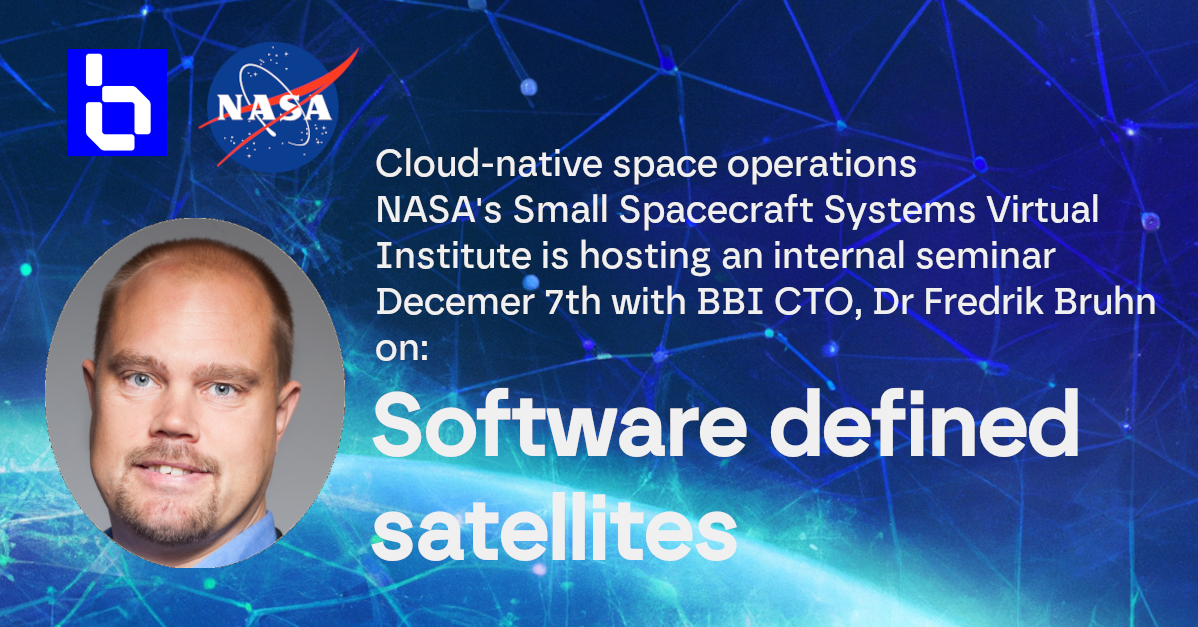
BBI’s CTO, Dr Fredrik Bruhn, will be presenting at an internal agency wide NASA industry S3VI day seminar on software defined satellites on December 7th hosted at NASA Ames Research Center in Silicon Valley.
Software-defined satellites offer unparalleled flexibility, adaptability, and efficiency, enabling new space missions that were previously impossible or impractical.
The presentation will take a wide look at the future of AI supported space infrastructure and exploration, based around the transformational example of a state-of-the-art 7nm radiation hardened American space computer for cloud computing and AI, and emphasize the advantages of utilizing cloud-native principles and technologies such as Generative AI in satellite application development. The seminar will include a live demo session.
Are you wondering how software defined satellites differ from traditional satellites?
Software defined satellites are a new generation of satellites that leverage modern computing technologies, such as cloud computing, artificial intelligence (AI), and machine learning (ML), to enable unprecedented levels of flexibility, adaptability, and efficiency. These satellites are based on modular and scalable designs, which allow for easy customization and rapid deployment.
In contrast to traditional satellites, which are typically designed with fixed hardware configurations, software defined satellites can be reconfigured on-the-fly based on mission requirements. This means that they can quickly adapt to changing conditions, such as changes in weather patterns or new scientific discoveries. Additionally, software defined satellites can leverage advanced data analytics and machine learning algorithms to optimize their performance and improve their efficiency.
Overall, software defined satellites offer a wide range of benefits, including greater flexibility, scalability, and adaptability, as well as improved performance and efficiency. As such, they are poised to play a significant role in the future of space exploration and satellite communications.
#bruhnbruhn #pilotingtheedge #newspaceeconomy